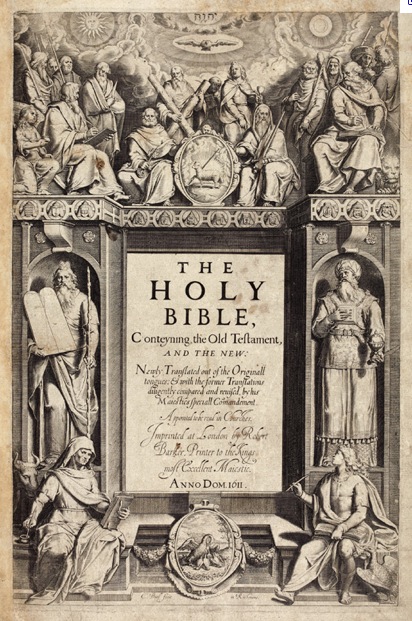
Surely if you lived around the Bible Belt long enough then you heard the old saying, “If it ain’t King James, it ain’t Bible!” Throughout my life I’ve seen it on Church signs and bumper stickers and heard it quoted like scripture in debates and conversations. Being raised by a father who refused to read the other interpretations of the Book, I admit I’m a bit biased towards the KJV. Several Orthodox monastics and priests have said the KJV is a good English translation and it is also what they read. It is clearly a more complete edition than later editions. For instance, there are many individual verses that appear in the KJV that have been removed by modern interpretations like the RSV, NIV, NLT, etc. Also there are entire chapters and Books that have been removed. From 1611 to 1885 KJV Bibles were printed with 80 Books, but since then they have been reduced to 66. 66? Really 66? What a number! Anyways, for a more complete picture of the Book, as an English speaker, the original 1611 AKJV is a good option. They’re hard to find, but so are pearls.
The cover of the original 1611 portrays an iconic scene. Although there is an element of the modern at play here in this image, there is also some very Orthodox imagery. I’ll admit, I never even understood or racked my brain on figuring out this cover, but when I became Orthodox it all slowly began to make sense.
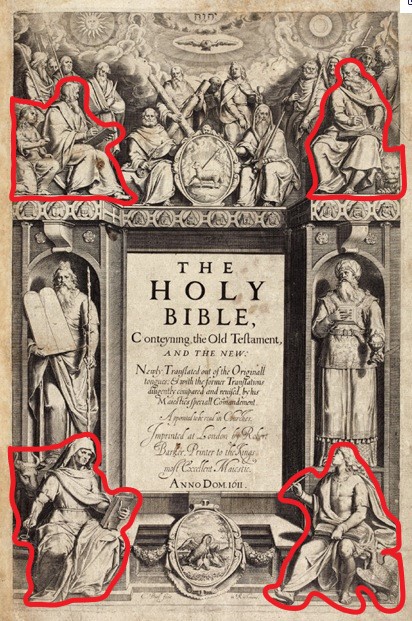
They say a picture is worth a thousand words, but let’s just focus on the highlighted gospel writers. When one walks into an Orthodox Church and see’s the icons hung round about they’re liable to notice the four Gospel writers Matthew, Mark, Luke and John represented with their accompanying symbols: the man/angel, the lion, the bull and the eagle. As it is in Heaven (Revelation 4:7, Ezekiel 1:5-14), also it is so portrayed in the Orthodox Church. Even the early Protestants hadn’t lost this understanding as is evident on this KJV cover. In a day and age of rampant iconoclasm in most of heterodox Christianity, the ability to have a theological picture worth a thousand words is being lost.
Folks struggle with the old English writing and antiquated speech of the 1611, but it is worth the toil to get the full picture. There are questions to be asked, “Why were entire chapters of Daniel and Esther removed?”, “Why were verses edited out of the NIV, NLT, etc.?”, “For what reason did Books that were quoted and expounded by Jesus and His Apostles get cut from the current prints of the Holy Bible?” and “How did the Holy Bible remain for 1885 years basically unaltered, until the current age?” There’s a host of answers, too, because these questions have been floating around the protestant church for over a hundred years. One answer out there says that the Bible was abbreviated to 66 books to save on printing costs. Another says the verses or books removed were due to “modern scholars” not believing them to be in the original text. Some go as far as to say that these “Apocryphal Books” and verses have never been in the true Bible even though there is no evidence for this in the near 2000 years we’ve had the Book.
The original 1611 is a useful tool to help us reconnect with the ancient Faith. The translators of the King James Version were, at the least, removed from over 400 years of confusion, competing confessions, johnny/janey come lately denominations, and the spiritual anarchy that has enveloped the Christian West. They were also “translators”. They “translated” the Holy Bible into English. The newer modern versions of the Bible aren’t “translations”, they are “interpretations”. It would do us all well to take the words and warnings of the Apostle Peter to heart when approaching our study of the Holy Scriptures so that we don’t read them to our “own destruction”,
2 Peter 1:15 Moreover I will endeavour that ye may be able after my decease to have these things always in remembrance.
16 For we have not followed cunningly devised fables, when we made known unto you the power and coming of our Lord Jesus Christ, but were eyewitnesses of his majesty.
17 For he received from God the Father honour and glory, when there came such a voice to him from the excellent glory, This is my beloved Son, in whom I am well pleased.
18 And this voice which came from heaven we heard, when we were with him in the holy mount.
19 We have also a more sure word of prophecy; whereunto ye do well that ye take heed, as unto a light that shineth in a dark place, until the day dawn, and the day star arise in your hearts:
20 Knowing this first, that no prophecy of the scripture is of any private interpretation.
21 For the prophecy came not in old time by the will of man: but holy men of God spake as they were moved by the Holy Ghost.
2 Peter 3:16 As also in all his epistles, speaking in them of these things; in which are some things hard to be understood, which they that are unlearned and unstable wrest, as they do also the other scriptures, unto their own destruction.
It seems like every year yet another, “clearer” interpretation of the Scripture is published. It makes me wonder if soon there’ll be as many Bible versions as there are denominations. So if you believe that “if it ain’t King James, it ain’t Bible!” then you’re on a noble path. Just make sure you’re reading the original 1611 to get the full picture.
 Orthodox Appalachia