If it ain’t King James, it ain’t Bible!

Surely if you lived around the Bible Belt long enough then you heard the old saying, “If it ain’t King James, it ain’t Bible!” Throughout my life I’ve seen it on Church signs and bumper stickers and heard it quoted like scripture in debates and conversations. Being raised by a father who refused to read the other interpretations of the Book, I admit I’m a bit biased towards the KJV. Several Orthodox monastics and priests have said the KJV is a good English translation and it is also what they read. It is clearly a more complete edition than later editions. For instance, there are many individual verses that appear in the KJV that have been removed by modern interpretations like the RSV, NIV, NLT, etc. Also there are entire chapters and Books that have been removed. From 1611 to 1885 KJV Bibles were printed with 80 Books, but since then they have been reduced to 66. 66? Really 66? What a number! Anyways, for a more complete picture of the Book, as an English speaker, the original 1611 AKJV is a good option. They’re hard to find, but so are pearls.

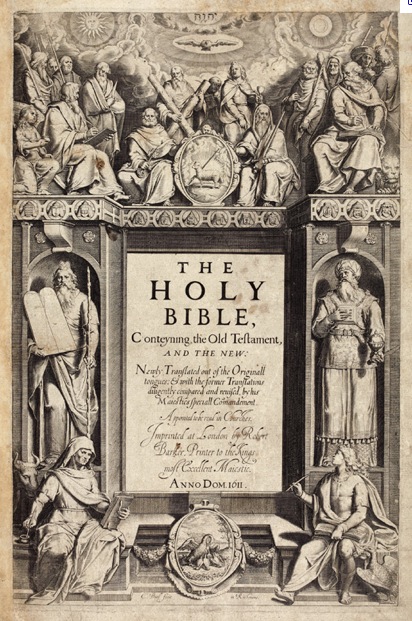
The cover of the original 1611 portrays an iconic scene. Although there is an element of the modern at play here in this image, there is also some very Orthodox imagery. I’ll admit, I never even understood or racked my brain on figuring out this cover, but when I became Orthodox it all slowly began to make sense.
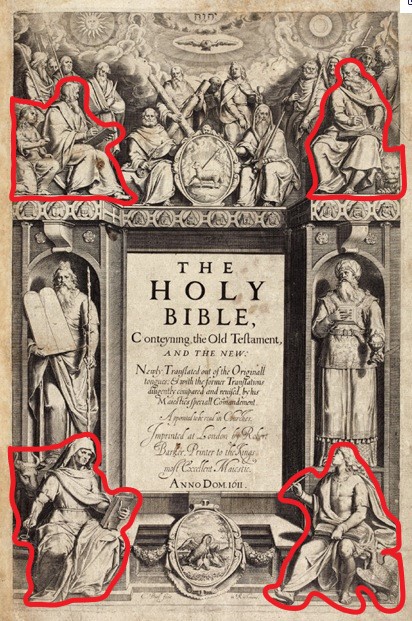
The Four Gospels Revelation 4:7, Ezekiel 1:5-14

They say a picture is worth a thousand words, but let’s just focus on the highlighted gospel writers. When one walks into an Orthodox Church and see’s the icons hung round about they’re liable to notice the four Gospel writers Matthew, Mark, Luke and John represented with their accompanying symbols: the man/angel, the lion, the bull and the eagle. As it is in Heaven (Revelation 4:7, Ezekiel 1:5-14), also it is so portrayed in the Orthodox Church. Even the early Protestants hadn’t lost this understanding as is evident on this KJV cover. In a day and age of rampant iconoclasm in most of heterodox Christianity, the ability to have a theological picture worth a thousand words is being lost.

Folks struggle with the old English writing and antiquated speech of the 1611, but it is worth the toil to get the full picture. There are questions to be asked, “Why were entire chapters of Daniel and Esther removed?”, “Why were verses edited out of the NIV, NLT, etc.?”, “For what reason did Books that were quoted and expounded by Jesus and His Apostles get cut from the current prints of the Holy Bible?” and “How did the Holy Bible remain for 1885 years basically unaltered, until the current age?” There’s a host of answers, too, because these questions have been floating around the protestant church for over a hundred years. One answer out there says that the Bible was abbreviated to 66 books to save on printing costs. Another says the verses or books removed were due to “modern scholars” not believing them to be in the original text. Some go as far as to say that these “Apocryphal Books” and verses have never been in the true Bible even though there is no evidence for this in the near 2000 years we’ve had the Book.

The original 1611 is a useful tool to help us reconnect with the ancient Faith. The translators of the King James Version were, at the least, removed from over 400 years of confusion, competing confessions, johnny/janey come lately denominations, and the spiritual anarchy that has enveloped the Christian West. They were also “translators”. They “translated” the Holy Bible into English. The newer modern versions of the Bible aren’t “translations”, they are “interpretations”. It would do us all well to take the words and warnings of the Apostle Peter to heart when approaching our study of the Holy Scriptures so that we don’t read them to our “own destruction”,

2 Peter 1:15 Moreover I will endeavour that ye may be able after my decease to have these things always in remembrance.

16 For we have not followed cunningly devised fables, when we made known unto you the power and coming of our Lord Jesus Christ, but were eyewitnesses of his majesty.

17 For he received from God the Father honour and glory, when there came such a voice to him from the excellent glory, This is my beloved Son, in whom I am well pleased.

18 And this voice which came from heaven we heard, when we were with him in the holy mount.

19 We have also a more sure word of prophecy; whereunto ye do well that ye take heed, as unto a light that shineth in a dark place, until the day dawn, and the day star arise in your hearts:

20 Knowing this first, that no prophecy of the scripture is of any private interpretation.

21 For the prophecy came not in old time by the will of man: but holy men of God spake as they were moved by the Holy Ghost.

2 Peter 3:16 As also in all his epistles, speaking in them of these things; in which are some things hard to be understood, which they that are unlearned and unstable wrest, as they do also the other scriptures, unto their own destruction.

It seems like every year yet another, “clearer” interpretation of the Scripture is published. It makes me wonder if soon there’ll be as many Bible versions as there are denominations. So if you believe that “if it ain’t King James, it ain’t Bible!” then you’re on a noble path. Just make sure you’re reading the original 1611 to get the full picture.

Through the Mud pt. 1

Most modern Christian churches are stuck in the mud. Rain, old ruts, sinkholes and dead end paths lead many astray, bog down a few more and cause even more to abandon the path and surrender the struggle. There is a way to clean this mud road up and lay the foundations of a solid, straight path.

If we study the Church back just to the last two centuries we will observe Christian practices that are unknown to modern Christians. Go a few more hundred years and we’ll see an even more unadulterated religion. Once we pave away back a thousand years there will only be a few ruts and mudholes to avoid. Obviously as we get back to the end of the path we find Jesus Christ and should have a mile of straight, clean road as a result. A very good book that very handedly shows us how to do this is the “Orthodox Survival Guide” by Fr. Seraphim Rose. However, lets look at this purely from traces we find here in our Appalachian Bible Belt Culture. The Orthodox Church might seem very alien to Appalachian people nowadays, but many of our Protestant great granddaddy’s would most likely understand the Orthodox Church better than the modern version of their particular denominations.

One example of this is in our music. Several of our old hymns have traces of Orthodoxy within them. We’ll look at three. The following Appalachian song “The Cherry Tree Carol” references the Virgin Mary as the “Queen”, a forgotten concept in many churches. It also states the birthday of Jesus as the 6th of January. The 6th of January would be the Old Calendar December 25th. The Orthodox Church and the Appalachians were the last people in the world to come onto the “New Calendar” of Pope Gregory. Most Orthodox Churches though are still on the Old Calendar. You can find out more about “Old Christmas” by clicking here

Another Appalachian Folk song from the Easter Brothers, which is a bit more contemporary, speaks about the Ladder. The Ladder is an ancient concept of the Church that has its first mention by Jacob in the Old Testament. Later in the 600’s it was expounded on again by St John Climacus in his “Ladder of Divine Ascent”. This is an important Christian teaching because it helps us to see our struggle and our climb in much more theological depth.

The iconic and still popular song, Angel Band, written in the 19th century has another hint to ancient Christianity in its verses. The idea that angels and demons surround us at the moment of our death may not be that uncommon in Christian circles. Yet understanding this very important moment when our Soul departs the Body is one of the areas the Orthodox Church is most prepared. There are specific and ancient prayers before, during and after death, for the departed Soul’s. Appealing to the Angels is a very traditional practice that is quickly fading away in modern Christianity.

The preservation of our native, Christian religion should be very important to us here in the “Bible Belt”. A lot of our folk ways are fading, losing relevance and simply being forgotten in post-modern America. One thing we cannot lose is our understanding of Jesus Christ and His Holy Church established by Him as a means to bring salvation to all peoples. One of the most effective ways the enemy has hurt the Church is by erosion. Slowly slipping knots in here and there and subverting entire flocks. Sacramental Worship is literally disappearing and some of those who do practice it don’t even believe its anything more than an antiquated expression. Like the “Popes Calendar”, it may take three hundred years for the enemy to dig a hole in our road. Or he could use a new hip “Christian” song with heretical lyrics that only takes him a few days to pour on us. Where else can we hope to fight so advanced an adversary, save our peoples souls, and advance Christ’s Kingdom here on earth than within the confines of His Holy Church? The Orthodox Church is the only hope for Appalachia, it is the only hope for America, and it is the only hope for the world. If you get stuck in the mud you must go in reverse to get the momentum to go forwards.

Old Christmas: January 7th By: AppalachianMagazine – January 6, 2020

snow

From our earliest of days, the people who settled the mountains of Appalachia have sought diligently to preserve their heritage, culture and language.  Our much derided accent, ancient customs and mountain knowledge is a source of pride to millions of Americans.

Even today, there is a comfort and longing from folks all around to return to the mountains and hollers of Appalachia — back to a forgotten world that seems foreign to the modern world and its man conveniences.

Among these forgotten Appalachian traditions is the celebration of “Old Christmas” — January 7th.

To understand why the early inhabitants of Appalachia celebrated Christmas two weeks after December 25th, we must first jump back in time nearly a half-century before the birth of Christ and visit the Roman Empire.

In the year 46 BC, Julius Caesar proposed a new calendar to be used throughout the entire Roman Empire — prior to this time, the land had been relying upon a convoluted system in which years ranged from 355 days to 383 days in length and had very little in common with the tropical year.

Caesar proposed a 365-day year and changed the first date of the year to January 1st and the modern-day calendar we still use today was birthed… or at least conceived. Caesar’s calendar, known as the Julian Calendar, was well received and even outlived the Roman Empire that had created it.

By the time white settlers began exploring the “Allegheny Mountains” (old name for Appalachian Mountains), the Roman Calendar was serving as the predominant calendar throughout Europe, the settlements in the Americas and elsewhere.

In the meantime, somewhere around the year 336 AD, December 25th began serving as a Christian observed holiday — eventually becoming known as “Christmas”, acting as a symbolic observance of Christ’s birth.

Unfortunately, the Julian Calendar had a major flaw — it was based on a 365-day year and did not take into account the fact that an actual year is roughly 365.25 days (to put it simply, it did not have a leap year).

In the years that followed, leap years would be added periodically, but not enough and soon this  oversight became so problematic that by the late-1500s, Roman Catholic Pope Gregory XIII felt that it was time to modify leap years and get things back on track with the astronomical calendar — this was primarily done so that the Easter holiday would be restored to the time of the year in which it was celebrated when first introduced by the early Church.

Gregory’s revisions, which removed ten days from the calendar was accepted by Spain, Portugal, France and Italy in 1582.

In Italy, Poland, Portugal and Spain, residents went to bed on October 4, 1582, and woke up the next morning on October 15, 1582.

In France, the switch came in December, with Parisians jumping from Sunday, December 9, 1582, to Monday, December 20, 1582.

In the centuries ahead, one by one, the nations of Europe followed suit, even protestant Great Britain and her American colonies in 1752.

Staunchly anti-Catholic, the fiercely independent Scots-Irish who had, by the mid-1700s, began settling the Appalachians were adamantly opposed to the notion of embracing a new calendar — a new calendar invented by Catholics and adopted by some distant government on the far side of the ocean.

The people of the mountains were unwilling to allow the government “to steal eleven days” from their lives.  Christmas had long been celebrated weeks after the winter solstice and the Appalachian settlers didn’t take kindly to the though of celebrating Christmas, the premier “winter holiday” only four days past the close of autumn.

Thanks to being isolated from the rest of the nation, the men of the mountains continued to celebrate Old Christmas 12 Days after the December 25th celebration date set by the new calendar.

In the years that followed, the settlers and mountain people of the hills had no choice but adopt the new calendar, allowing the government to “steal” those eleven days from their lives; however, in a final act of defiance, they resolved to continue celebrating Christmas precisely one year to the date their ancestors celebrated the holiday — which so happened to fall on January 7.

January 7 became the new date many of the families and communities selected to celebrate Christmas, Old Christmas.

The practice of celebrating “Old Christmas” in the Appalachian Mountains continued on for generations.

In the years that followed, superstitions and lore would spread regarding to magical powers of old Christmas. It was said that on Old Christmas Eve, the animals would kneel and even speak.

As an old Kentucky poem about Old Christmas proclaims,

“They’s heaps o’ folks here still believe,
On Christmas – that’s Old Christmas – Eve,
The elders bloom upon the ground,
And critters low and kneel around,
In every stall, though none I know
Has seen them kneel, or heard them low…”

Nearly all of the modern Christmas traditions we know today were born during the 1800s, and it was during this same time that the sons of many of the Appalachian mountianmen surrendered to celebrating on December 25.

Today, there remain a few holdouts who continue to celebrate “Old Christmas” in the Appalachian hills; however, they are a dwindling number.  In another generation or two, celebrating “Old Christmas” will be just another forgotten part of Appalachian history.